
2/3/2026
Remember 2022 and the release of ChatGPT? Did you know that the energy required to train that model was equivalent to the daily power consumption of 43,680 U.S. homes? 1 And did you know that the energy cost has been increasing by 2.4 times each year? 1 And that the daily energy requirements to run GPT-5 are estimated to be the equivalent of a medium-sized city (we don’t know for sure, because Open AI don’t disclose the true figure).2
And did you know that Big Tech companies (e.g. Google, Meta, Microsoft, OpenAI, etc) plan to build 10 massive data centres that will consume the energy equivalent of the U.S. state of New Hampshire? 3 These power demands require building nuclear power plants and drive up energy prices. Current data centres like these are causing noise pollution and depleting precious drinking water supplies in rural communities, leading to shortages. 4 5 6 7
According to the International Energy Agency (IEA), “data centres accounted for around 1.5% of the world’s electricity consumption in 2024, or 415 terawatt-hours (TWh)”. Each data center consumes as much electricity as 100,000 homes. But the largest ones under construction today will consume 20 times as much, and they project that combined energy footprint of these data centres are set to reach 945 TWh by 2030. This is equivalent to the current annual energy consumption of Japan. 8
AI models have been linked to suicides, self-harm, and radicalisation.9 10 11 To date, there are multiple documented cases of AI providing suicide or self-harm instructions, with OpenAI shifting blame to users. 11 Grok and Elon Musk have recently been embroiled in a scandal over an image model that can undress any subject from any image. Even kids. 12 And Elon’s response? To monetise by putting that feature behind a paywall. 13
The list on ethical breaches is ever-growing. Simply put, there is a collapse in the ethical standards of these companies. Many AI companies have cut ethical oversight teams (e.g., Google disbanded its AI ethics council in 2019), and OpenAI’s safety board quit after accusing the company of failing to listen to their concerns. All while expanding risky deployments and admitting the transformative aspect of AI. Google also removed pledges to avoid using its AI in weapons and surveillance systems. 14
What I’ve mentioned so far is just the tip of the iceberg. I recommend reading Karen Hao’s “Empire of AI” on the subject, as well as the papers and sources linked in this article’s References section.
Reading that book, and those papers might make you feel like you’re being dragged by the system, powerless to do anything. After all, we all live in a system that requires us to use AI for our jobs.

But what if I told you that we, in fact, do have the power and agency to make a difference? What if I told you the solution is actually very simple? Later, I will lay out what I believe is an effective solution to this problem. But first, I wanted to address some pushback I often hear when people are confronted with the above facts.
What are we getting for rising energy prices?
“But what about progress? Isn’t all that just unfortunate collateral damage? Isn’t all that just a cost of innovation?”
The above summarises a common pushback, but the statement assumes progress is being made. Is that really the case? Let’s explore that a little. Firstly, there are concerns that LLMs are being trained on the benchmarks used to measure their progress. In other words, the vendors are knowingly or unknowingly allowing the models to cheat, and so the entire view of progress could be a lie! 15
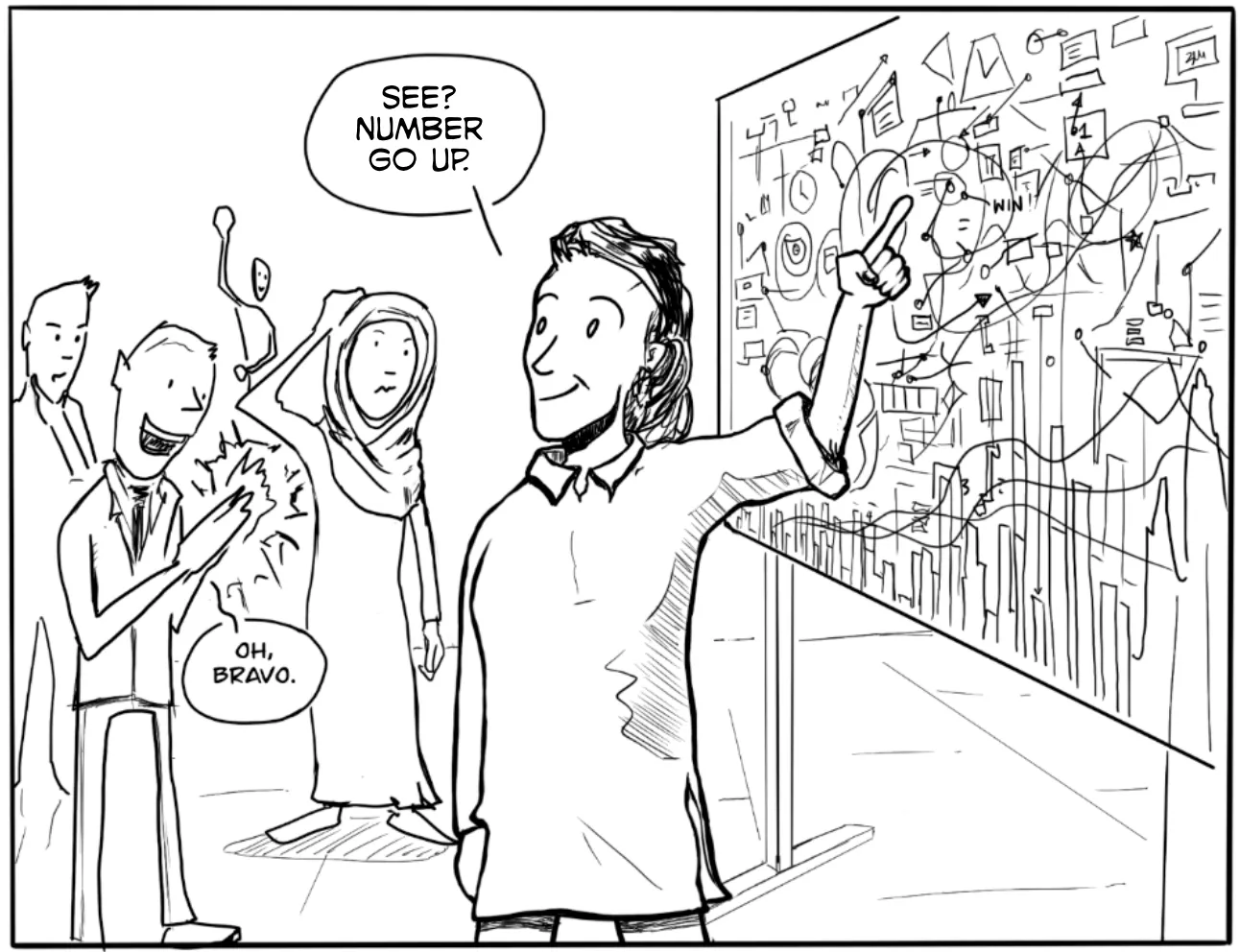
There are also inaccuracies in how model performance is being marketed. For instance, take context windows (the amount of text that generative models can process), Google claims its Gemini models can process the equivalent of the entire Harry Potter series. The reality is that the models are optimal for three pages. 16 Quite a difference, right?
Meanwhile, there’s growing dissatisfaction with AI’s performance, with a paper reporting a mere 30% success rate for AI Agents in real-world use. 17 And, even if you choose to trust the aforementioned benchmarks, there is a suggestion that the ceiling for LLMs has been reached. 18 Meanwhile, Apple’s paper, “The illusion of Thinking”, indicated an “accuracy collapse”. 19
In summary, when it comes to progress, the costs are piling up, with little to no return on investment. And by using Big Tech’s models, we enable their worst tendencies. So, now enough of defining the problem, let’s get to the solution, because it really is quite simple.
The Solution is Small
I think we need to re-evaluate our relationship with this technology. Instead of using the flagship models that Big Tech pushes on us, use language models that are much more power-efficient. If, while doing that, we also change the way we work with AI, we can get better outputs. Let’s see what this all means in practical terms.
1. Using alternative models
Contrary to popular belief, the Big Tech companies do not have a monopoly on generative text and image models. There are many open-sourced options available, some of which are very energy-efficient. Using a service like OpenRouter is the easiest way to access all these models in the cloud. Alternatively, if we have a capable machine, we can use the LM Studio app to run models on the smaller end privately on our own hardware. This has a privacy benefit, too.
It’s important to note that just because a model is small, it doesn’t necessarily mean we’re compromising on quality. I say “necessarily” because there are different grades of “small”. You can choose tiny models if you want to build out workflows, or, if you prefer using large, complex prompts, you can opt for a slightly larger model. Overall, there is evidence that smaller models are more accurate than larger ones. 20
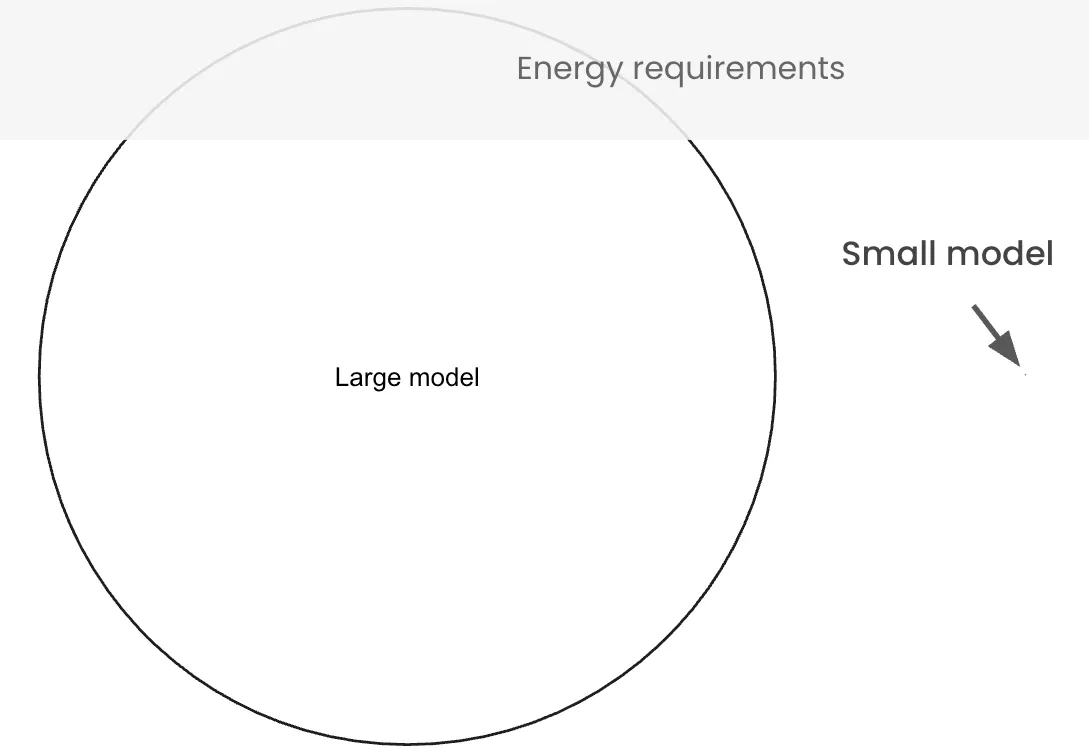
For instance, after much benchmarking against Claude Sonnet, my current small model of choice is the Ministral 3 14B. This is good enough for most of my tasks. For coding, I’ve found Qwen3 Coder and Devstral to be excellent choices.
It’s worth noting that “small” doesn’t necessarily mean “specialised” for specific tasks. Often, these models are just trained differently, leading to higher accuracy with less data. 14 Finding an alternative model requires some trial and research to identify the best one for our specific tasks. It’s not hard, and doing this is enough to break our dependency on Big Tech.
If we also want to improve the output beyond the models Big Tech is providing, we can take things further.
2. Understand your “tools”
Generative AI and text models are tools. As such, they are useful in some cases but less so in others. It’s important we understand these strengths and limitations.
I described earlier how the effectiveness of LLMs is being miscommunicated (see the context window example). This is made worse by people hyping the technology using anecdotes of their AI use cases. Nobody is arguing that LLMs can occasionally generate something great. The problem is consistency. They’re outliers that cannot be repeated reliably enough to be trustworthy (and therefore useful).
That’s not to say all AI use cases are bad. But how can you tell? Answer: By simply understanding a little deeply how these technologies work. Here’s a quick summary of what we need to know and understand.
Language models are prediction engines. When you enter a prompt, a language model predicts which other words could go together. Essentially, they “generate” new text using the patterns they’ve been trained on.
At a basic level, this is the core competency of a language model. Language models have no sense of reasoning or of knowing what is true or false. Hallucination is a feature, not a bug.
Knowing this fact means we can restrict the use of Generative AI to what it is good for: generating text and code based on patterns.
We also need to understand that our current tools are not deprecated. Tools (like databases, APIs, scripts, etc.) are useful because, unlike AI, they are reliable and predictable. Their output is repeatable. For example, use a calculator with a formula, and it will always give you the same answer. That’s good.
Note: Some of the “flagship” models from Big Tech companies often include built-in tools. These tools are often scripts created to run and respond to specific prompts. There’s no transparency into how these tools work or into how to validate their output. These tools can often perform inconsistently.
Our first choice, therefore, should be to use tools that are transparent and that allow us to validate the output. There are countless ready-made APIs and scripts that we can “plug” into our chat or workflow tools. All this has been made easier by the Model Context Protocol (MCP), which enables plug-and-play communication between tools. There may be a small one-time investment to learn how to use and integrate MCPs, but it’s a cost worth absorbing.
If a script or tool does not exist, we can take the initiative to create bespoke scripts to use instead. We can use Generative AI to help us write these tools based on their patterns. And again, there is a one-time learning cost associated with creating and validating these tools. But you don’t need to become a “full-blown” developer; you just need to learn how to run and validate the code you create.
3. Understanding how we work
Finally, how can we introduce a new tool into our workflow if we don’t understand how we work? For example, here is a very rough outline of how we create things:
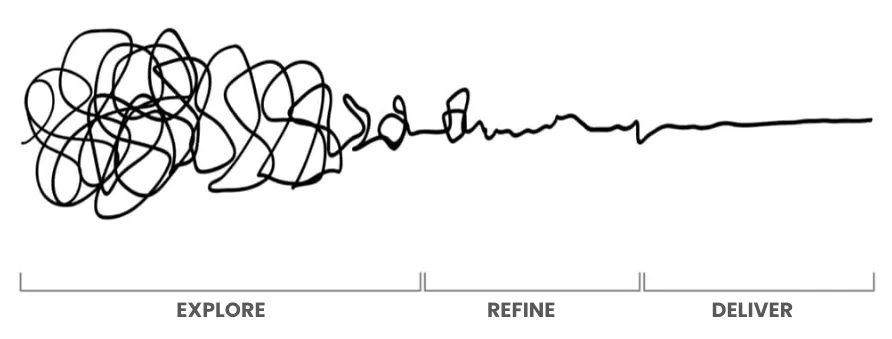
For instance, if we were to take the goal of writing an article, we might start with a rough idea of a topic. Then we’d research and brainstorm specific article ideas until we had a clear idea of what we wanted to say. This is the Explore stage. Each turn of the line is a pivot in a new direction, a new idea or take, or perhaps a direction for research.
Then, after we’ve decided on the idea for our article, we’d move to the Refine stage. This is where we might validate whether our approach works and if our perspective is valid. We might remove irrelevant information that distracts from our core message. We might also review ways to structure our article before deciding on the final structure and the core content that communicates our perspective.
And then finally, after refining, we’d move to the Delivery stage, where we’d get to work crafting the final article. We’d decide on sentence structure, metaphors, paragraph flow, or ways to better communicate our perspective. We’d check our grammar. The output of this step would be the final article.
Each stage is a different type of activity, requiring a different mindset. Brainstorming in the Explore stage is very different to crafting sentences in the Deliver stage. One is about generating ideas; the other is about picking the best way to communicate a point (perhaps from a list of options). Therefore, we’d need to use Generative AI differently, as shown below.
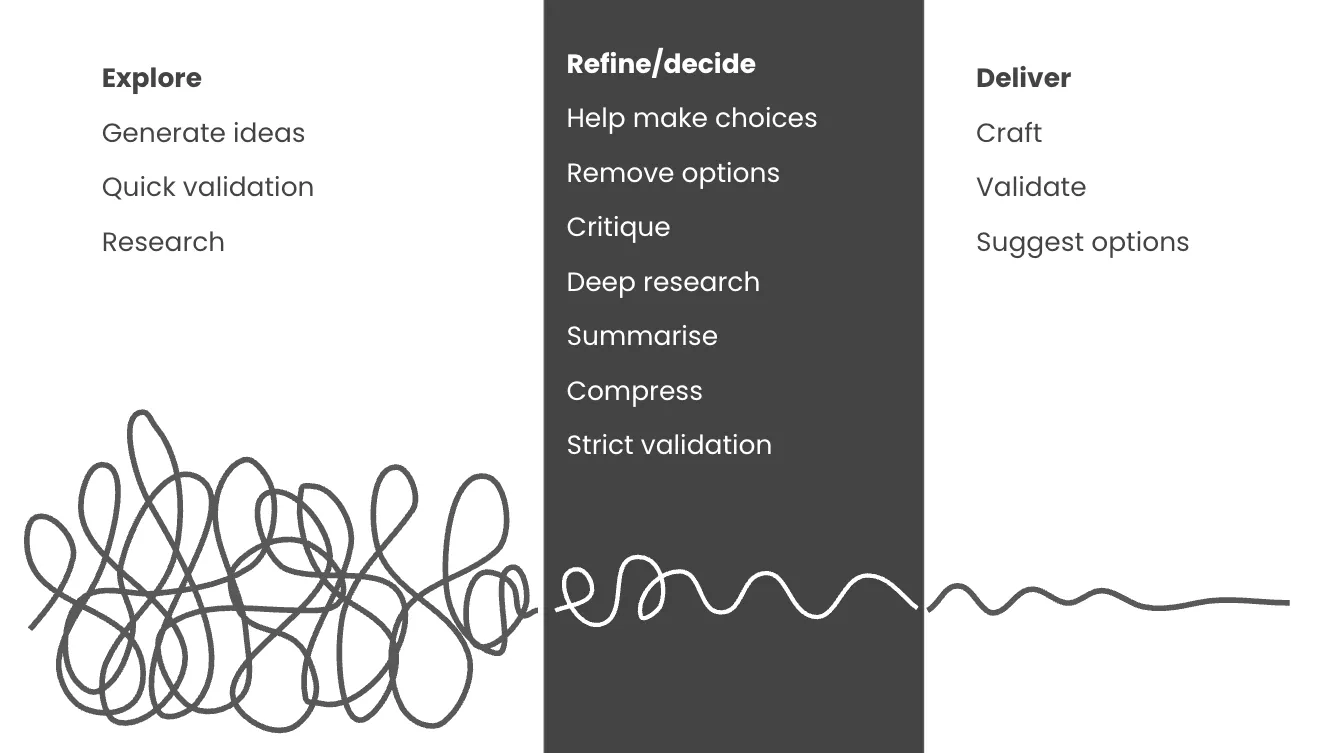
Also, throughout all of these stages, we make many choices. These “choices” are what make our creations uniquely ours. Different people make different choices. The problem with using AI is that we often force ourselves to “jump” too far ahead to the final output. And thus, many choices are made for us by AI, leading to us “losing our voice.”

Understanding all this means we can break down the act of producing something into smaller tasks, using AI in a way that preserves our voices. What this might end up with are specific “interaction patterns” that emphasise us and our choices throughout the process.
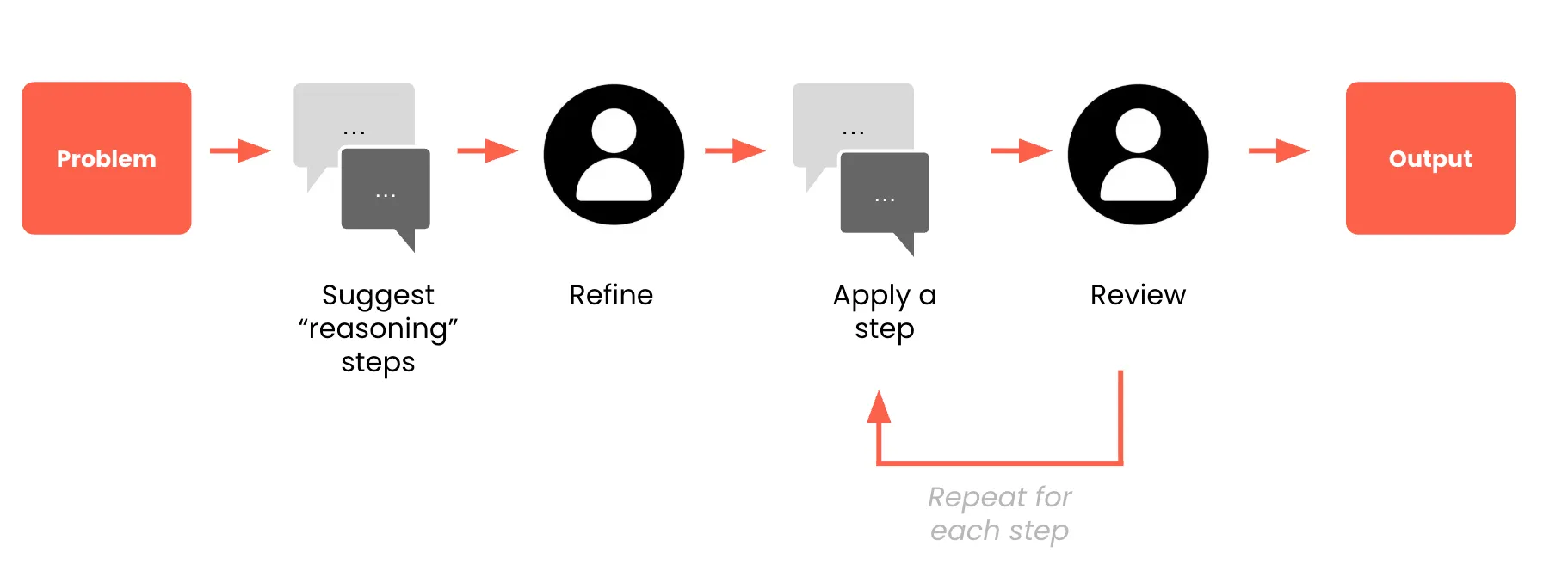
If we decide to automate some decisions, we could automate steps and create workflows in tools like n8n or Make.
Conclusion
The environmental and ethical costs of using generative AI are real and with us now. They’re not something to worry about for the future; they’re something to worry about now. The fact that Big Tech companies are investing in ever-larger data centres suggests we’re heading on an unsustainable and destructive path.
Fortunately, we are not powerless. We have viable alternatives right now in the form of open source, small models. AI development CAN be ethical and sustainable. Not only that, but by using the technology to their strengths, not promises, leads to making better use of the technology.
Our future workflows do not need to be dictated by AI. We can custom-build our own solutions that are more ethical, that preserve our voices, and provide us with greater control and transparency.
Are you ready to change how you work? I’ll post more guides soon. In the meantime, if you or your company needs help making the move to smaller models, reach out for a chat.
References
Footnotes
-
ChatGPT 5 power consumption could be as much as eight times higher than GPT 4 — research institute estimates medium-sized GPT-5 response can consume up to 40 watt-hours of electricity ↩
-
We did the math on AI’s energy footprint. Here’s the story you haven’t heard. ↩
-
Making AI Less “Thirsty”: Uncovering and Addressing the Secret Water Footprint of AI Models ↩
-
The hidden costs of AI: Data centers, water, and the future of rural America ↩
-
ChatGPT shares data on how many users exhibit psychosis or suicidal thoughts ↩
-
X Didn’t Fix Grok’s ‘Undressing’ Problem. It Just Makes People Pay for It ↩
-
Distilling Step-by-Step! Outperforming Larger Language Models with Less Training Data and Smaller Model Sizes ↩ ↩2
-
The Vulnerability of Language Model Benchmarks: Do They Accurately Reflect True LLM Performance? ↩
-
TheAgentCompany: Benchmarking LLM Agents on Consequential Real World Tasks ↩
-
Impact of Model Size on Fine-tuned LLM Performance in Data-to-Text Generation: A State-of-the-Art Investigation ↩